Build Systems, Not Willpower. Engineering a Life That Holds Under Pressure
This one isn’t about a framework or a config flag. It’s about something that sits underneath all of that, how you structure your life so it holds up under pressure.
I’ve been through periods that tested everything, financially, personally, professionally. Many of us have.
What I want to talk about is the things that actually worked, because they turn out to be the same principles I’ve spent over two decades applying to architecting and shipping software: building systems that keep working when willpower runs out.
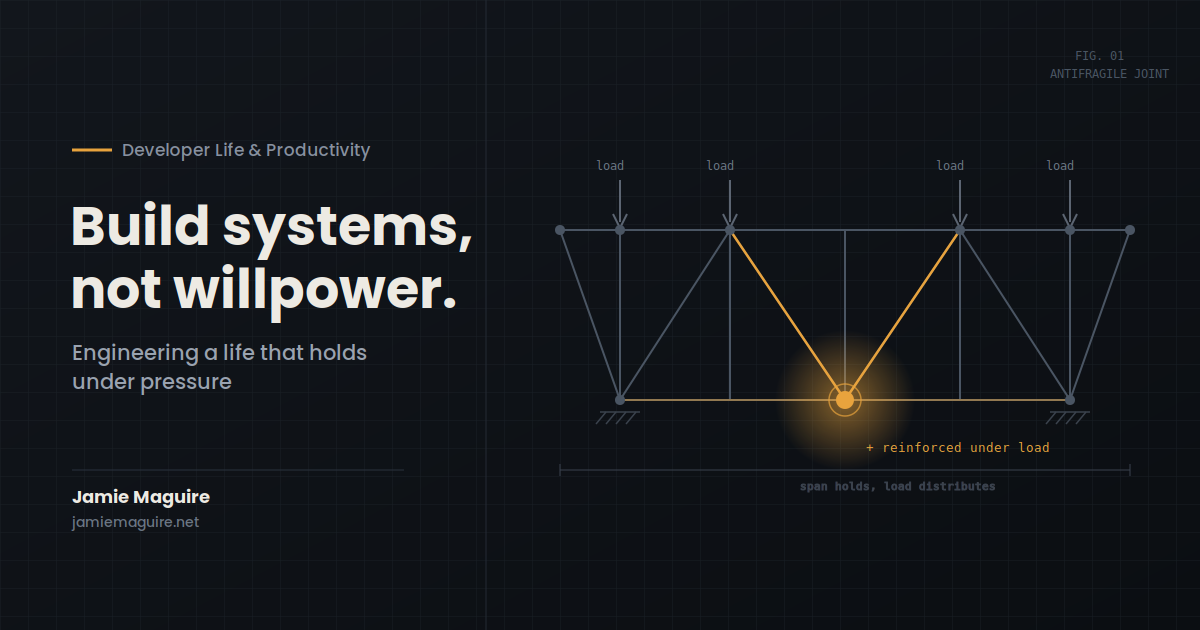
There’s a real difference between resilience and antifragility, and once you see it, you can’t unsee it. This is the difference that makes the difference.
Let’s dig in.
~
Resilience Bounces Back. Antifragility Comes Back Stronger.
The term antifragility, popularised by Nassim Nicholas Taleb, describes systems that don’t simply survive stress. They improve because of it.
Resilience is about absorbing a hit and returning to where you were. Antifragility goes further. The pressure itself becomes part of the process that makes you stronger.
Strength training works this way. Distributed systems can work this way when you design them to, and so can people.
The structures I built during the hard periods didn’t just help me get through them. They became the foundation for everything that came after. That’s the part worth paying attention to.
~
Build Systems, Not Willpower
Willpower depletes. Systems keep running. Any engineer already knows this instinctively. You don’t ask a human to remember to run the tests, you put them in the pipeline.
You don’t rely on someone choosing to format their code; you wire it into the commit hook. The whole discipline of software engineering is the slow removal of “someone will remember to” from anything that matters.
Apply that to a life under pressure and the same principle holds. When everything around you is uncertain, your daily structure becomes the anchor.
Consistent training. Focused work in protected blocks. Financial discipline that runs automatically. These are structures you build once and repeat until they become part of how you operate.
Motivation comes and goes. You cannot build anything durable on a variable that resets to zero every time you’re tired, stressed, or blindsided by whatever life throws at you.
~
Good Habits Compound Sideways, Not Just Forward
Antifragility isn’t just about time; it’s about how the pieces connect.
- Remove alcohol and sleep improves
- Sleep improves and training gets easier to show up for
- Training goes well and the discipline carries into focused work blocks
None of these exist in isolation. They’re a dependency graph, and getting one node right lowers the cost of the next one.
Each spills into the next and you create an upward spiral.
This is the same reason a clean codebase compounds and a messy one doesn’t.
Well-scoped work makes the next piece of work cheaper. Poorly-scoped work makes everything after it more expensive. Habits behave the same way. Stack the right ones and each new one gets a discount.
~
Design for Autonomy from the Start
I deliberately reduced fixed obligations wherever I could. For me that meant location independence, no consumer debts, and very few commitments.
This is loose coupling applied to a life. Every dependency you take on becomes a constraint on how you can respond when conditions change.
Debt is a hard dependency with a fixed schedule that does not care about your circumstances. Financial flexibility gives you room to change direction when circumstances change.
Design the system so that when pressure arrives, you still have room to act. Maximise optionality.
~
Control the Controllable
There are systems, people, and circumstances you cannot change. Directing energy at them is a tax with no return. You are spending your one finite resource on a process you don’t own and can’t deploy to.
The alternative is to put that energy into the parts of your life where your actions have an effect.
Engineers waste enormous energy here too: raging at a vendor’s broken API, a decision made three levels up, a market that moved. Note it, route around it, and put the energy back into the part of the surface you actually control.
The compounding is real, and it only happens on the inputs you own.
~
Know Who You Are
Difficult periods strip away everything that isn’t load-bearing. It’s not pleasant, but it’s clarifying. What’s left standing afterwards is a very honest picture of your values, your actual capabilities, and what matters to you.
Everything decorative gets removed.
The trap is letting the difficulty define you. Don’t let what happened become the entire story. Pay attention to what you built in response.
I’ve worked in technology for over twenty years, built products from scratch, and designed a professional life around autonomy on purpose. None of that happened in a vacuum. The hard periods were part of the process.
~
Convert Adversity Into Direction
Every difficult period left something behind, clarity, capability, or both. That residue is the useful part.
The question becomes: “What did I build because of it, and where does that point me next?”
Adversity is data. Treat it like a post-incident review: the outage already happened, so the value now comes from what you change because of it.
~
The Long Game
Nothing worthwhile happens quickly.
The professional reputation took two decades. Physical health came from hundreds of individual training sessions, most of which felt like nothing on the day.
Antifragility is a long game played through daily discipline, the same unglamorous consistency that turns a codebase from a liability into an asset.
Small correct commits, compounding, for a very long time.
~
What to Watch Out For
A few ways this goes wrong:
- Confusing motion with structure. Reading about systems, buying the planner, and talking about discipline can feel productive. The test is whether the structure actually changes what happens on an ordinary Tuesday. If it still requires you to decide each day, keep working on the system.
- Optimising for the good weather. A structure needs to survive tiredness, stress and disruption. Those are the conditions that reveal whether you’ve built something useful. Peace-Time versus War-Time etc.
- Spending energy on the uncontrollable. It feels productive. It returns nothing. Audit where your attention actually goes.
- Expecting it fast. The compounding is real but slow. If you quit before the curve bends, you never see it. Most people quit before the curve bends.
Reflect on these.
~
Three Questions Worth Sitting With
- What structures are you building right now that will carry you forward when conditions get worse?
- What are you still trying to control that you genuinely cannot, and what would you do with that energy if you reclaimed it?
- What has difficulty already taught you that you haven’t yet put to use?
If you’re in a hard period right now, personally or professionally, the structures you build today are the ones that carry you forward.
~